
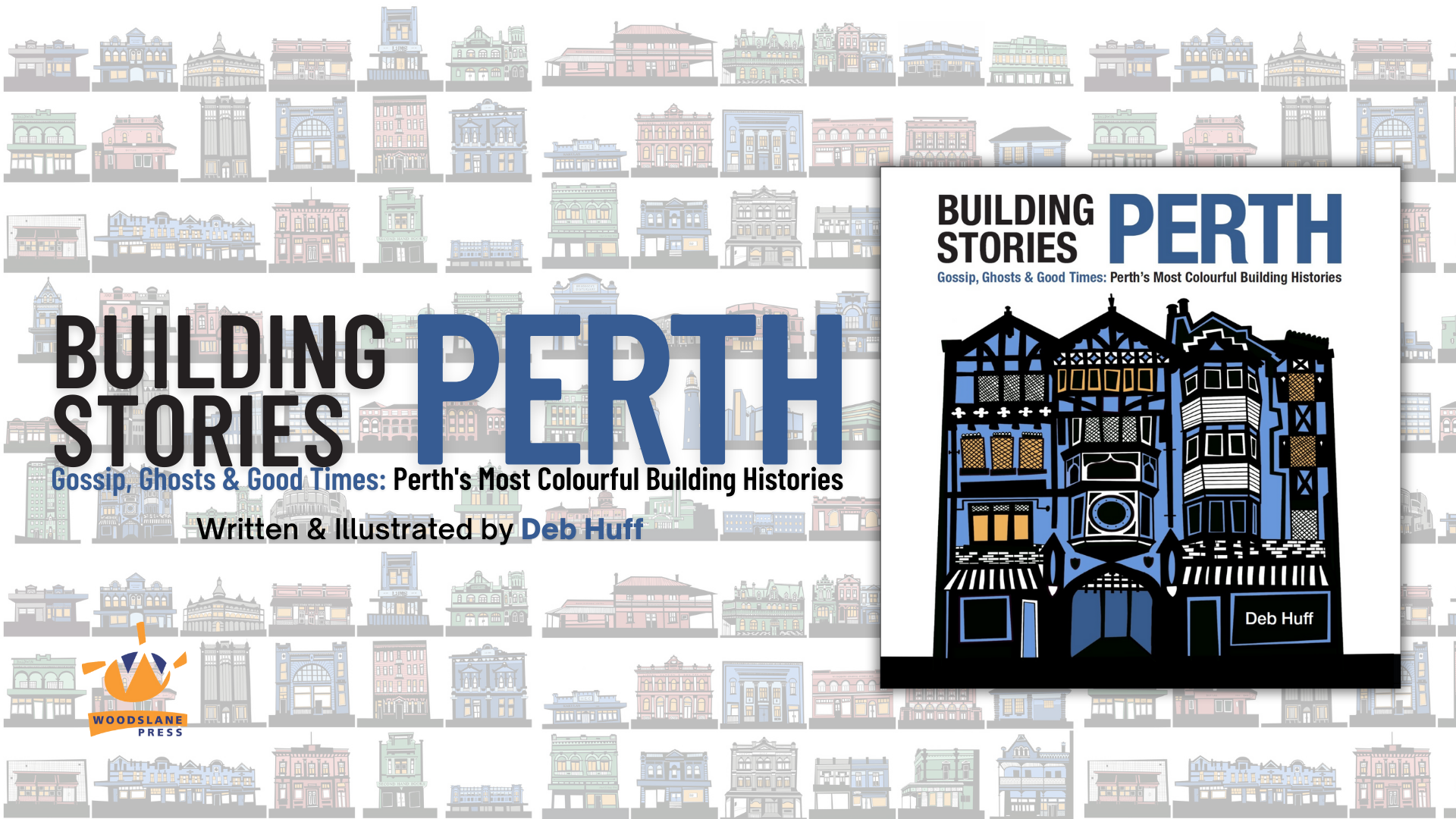
Uncover the gossipy pasts surprising transformations, and the everyday stories hidden behind familiar façades. The book explores how buildings evolve—and how their layered pasts continue to shape the city today.
Author and Illustrator Deb Huff has crafted a celebration of the hidden mysteries behind some of Perth's most iconic infrastructure. Read on for the behind the scenes insight into her creative processes, her passion for her art and how the book came to be!
What brought you to loving heritage, particularly Perth?
I’ve always loved old buildings, old stories and figuring out what a place used to be. I’m naturally curious (or nosy, depending on who you ask!) and I find it impossible to walk past an interesting building without wondering who built it, who worked there, what big conversations happened there, what businesses have come and gone, and what the street looked like fifty or a hundred years ago.
When I moved to Perth in 2020, I started drawing my neighbourhood and then the city more widely as a way to learn about my new home. What surprised me was how quickly I realised that every building seemed to have a story. Once I started researching them, I couldn’t stop.
Have you always been artistic or is drawing buildings a new art form for you?
I’ve experimented with a few different mediums over the years. Buildings were actually a bit of an accidental subject. During COVID, I started drawing the buildings around my neighbourhood in Maylands as a way to get to know the area. It was part creative project and part local history lesson. The more I drew, the more I researched, and before long I had dozens and dozens of drawings and a growing collection of stories about Perth’s built heritage.
What began as a personal project eventually turned into Building Stories: Perth.

What is the one story that has resonated the most with you in your research for Building Stories: Perth?
The Royal Hotel is one that has stayed with me. It’s such an iconic Perth building, but what really fascinated me was the number of lives it’s lived. It has survived economic downturns, changing fashions, redevelopment pressures and long periods of uncertainty, yet it remains one of the city’s great gathering places.
I also love the story behind Shadow Wine Bar. What looks like a stylish contemporary venue today started life as a bank, and the contrast between those two identities says so much about how cities evolve. Those kinds of adaptive reuse stories are some of my favourites because they show how heritage buildings can remain relevant without losing their connection to the past.
More broadly, what has resonated most is discovering how many of Perth’s best-loved places exist because someone cared enough to save them. Again and again, I found stories of owners, volunteers, businesses and community groups who fought to preserve buildings that could easily have disappeared.
The Rechabite is a wonderful example. What began as a temperance hall survived decades of change and uncertainty before being brought back to life as one of Perth’s most vibrant cultural venues. The Royal Hotel tells a similar story. These buildings are still part of our city because people saw value in them and were willing to invest time, money, energy and imagination into their future.
Another incredible example is the West Australian Ballet. The building they now call home used to be the Royal Institute for the Blind, and I think it’s one of the best adaptive reuse projects in the country. The organisation was also incredibly generous with their knowledge and access while I was researching the book.
How did you pick which stories and buildings to include? Was it a quick Google search or insider knowledge?
A bit of both!
Some buildings were obvious choices because they’re iconic Perth landmarks. Others came from conversations with locals, business owners, colleagues and friends. Often someone would casually mention a building, I’d go away and start researching, and find all sorts of unexpected stories in Trove and elsewhere.
The most rewarding discoveries were usually the unexpected ones. I’d start researching one building and uncover a completely different story about a family, a business, a community organisation or a moment in Perth’s history that I hadn’t known about before. For example, London Court (on the cover) and Lawson Flats were built in the same year (1937) and were both examples of inner-city studio and apartment living in Perth, perhaps earlier than most people expect.
A lot of the book was built from those surprises.

What has been the best part about learning the hidden stories of Perth?
Feeling connected to the city in a completely different way.
Perth stopped feeling like a collection of streets and buildings and started feeling like a place layered with personalities, memories and stories. Once you know what happened behind a facade, you never look at that building the same way again.
The other rewarding part has been sharing those discoveries with other people. One of my favourite things is hearing someone say, “I’ve walked past that building hundreds of times and had no idea.”
What is your favourite method of research? Digital or analogue? Reading or listening?
Definitely both!
My ideal research process usually starts with a conversation over a coffee or a glass of wine. Someone tells me a story, mentions a building or shares a memory, and then I go hunting for more information.
After that, I disappear into Trove, old newspapers, heritage records, library archives and photo collections. I love the detective work of connecting small pieces of information until a bigger story starts to emerge.
So if I had to choose, I’d say listening first, then reading. For me, they go hand in hand.
What has been the most exciting part about becoming an author as Building Stories: Perth hits shelves around the country?
It’s been equal parts exciting, surreal and slightly overwhelming in a lovely way.
For years this project existed mostly in my head, on my laptop and on my iPad, so seeing physical copies in bookshops has been a really special experience. Walking into a store and spotting it on a shelf still feels strange.
The most rewarding part has been seeing people connect with the stories. I’ve had conversations with readers who have worked in some of the buildings, lived nearby, or have family connections to places featured in the book.
It’s also been wonderful to discover how enthusiastic people are about Perth. The book has become a reason to have conversations about local history, architecture and community stories, and I feel very lucky to play a small role in helping people see the city differently.
For anyone wishing to visit Perth, what places should be on their must-visit list?
I’d start with the State Buildings precinct. It’s one of Perth’s best examples of heritage buildings finding a new life, and it’s a wonderful place to have lunch or dinner and a wander around.
I’d also recommend visiting the Royal Hotel and Shadow Wine Bar, both of which feature in the book and showcase different sides of Perth’s architectural history.
For a day trip, head to Fremantle and simply wander around. High Street alone is packed with fascinating heritage buildings, shops, bars, studios and layers of history.
I’d also suggest exploring the Perth Cultural Centre, London Court, the State Library, the historic buildings around St Georges Terrace, and Kings Park for a broader sense of the city.
Most importantly, look up. Some of Perth’s most interesting stories are hiding above modern shopfronts, tucked into old facades and sitting quietly in plain sight.


Building Stories: Perth is a treasure trove of engaging story telling and vibrant illustrations. A book that will equally look beautiful on your bookshelf or coffee table and one you will start reading, simply unable to put it down. Truly the best of both worlds.
Purchase your copy in all good bookstores, in some of Perth's most iconic galleries, museums and shops or online HERE.